
Florida’s Python Crisis: What 2026 Field Conditions Reveal About the Everglades’ Future
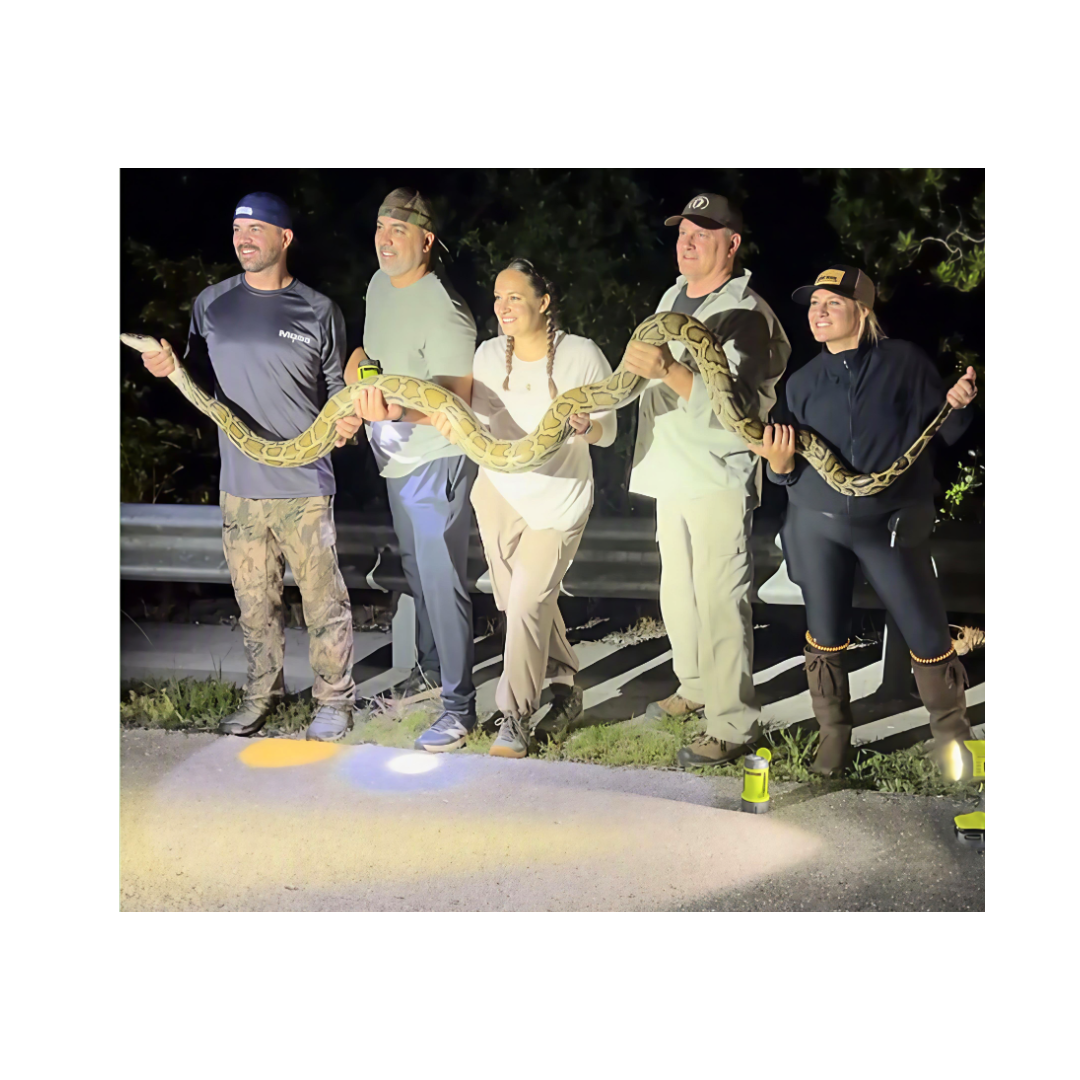
Five clients stand together in the Everglades, each gripping a massive 14‑foot+ Burmese python with both hands. The snake’s body stretches across the entire group, its thick coils supported along their arms and shoulders. Everyone is bracing under the weight, leaning slightly to balance the size of the animal. The group’s expressions range from excitement to disbelief as they hold the invasive predator, highlighting both the adventure and the reality of python removal in South Florida.
Florida’s Python Crisis: What 2026 Field Conditions Reveal About the Everglades’ Future
The Florida Everglades supports a remarkable variety of wildlife. The National Park Service identifies the invasive Burmese python as a serious threat: these well-camouflaged snakes prey on native animals and are difficult to detect and remove.
This year’s Florida Python Challenge has brought renewed attention to the crisis, but the real work happens long after the event ends. Independent operators like Airboat Adventures Everglades, led by Captain Greg, spend every month of the year removing invasive species and documenting real‑time conditions across the marsh.
The Science Behind the Crisis
The Burmese python is not native to Florida. The U.S. Geological Survey confirms the species likely became established through escapes and releases from the exotic pet trade. USGS Burmese Python Research: https://www.usgs.gov/faqs/how-have-invasive-pythons-impacted-florida-ecosystems
Burmese pythons are established across suitable habitats in South Florida. Their camouflage makes them difficult to detect, and they eat a wide range of native wildlife. Large females can produce substantial clutches of eggs, which is one reason preventing further spread matters.
A 2012 study compared road-survey observations before and after pythons became widespread in Everglades National Park. Surveys from 2003–2011 recorded declines of 99.3% in raccoon observations, 98.9% in opossum observations and 87.5% in bobcat observations. These are historical changes in survey encounter frequency, not a 2026 census of all Everglades mammals.
These losses ripple through the entire food web, affecting predators like alligators and the endangered Florida panther.
What Captain Greg Sees in the Field
While scientific studies reveal the scale of the crisis, the day‑to‑day reality is seen on the ground.
During removal operations, Captain Greg reports encountering python breeding aggregations, with males gathered around a female. These are his field observations of breeding behavior; they do not by themselves measure python density or demonstrate a regional population increase.
Greg reports photographs from his work showing pythons with large prey, including deer and alligators. These are part of his personal field account. Published research documents python predation on native wildlife, but it does not independently authenticate the circumstances of Greg’s photographs.
Nothing staged. Nothing dramatized. Just real Everglades conditions.
Drought, Wildfires, and CBS Miami Coverage
Water levels and wildfire conditions affect habitat and access for fieldwork. Greg describes how those conditions change what he encounters along his routes; his observations do not establish a regional python population trend.
Captain Greg has appeared on CBS Miami discussing how drought and wildfire conditions reshape wildlife behavior across the Everglades. CBS Miami – Everglades Coverage: Watch the CBS Miami Everglades coverage
These environmental shifts make removal efforts even more critical, especially during breeding season.
Greg’s Recent Mink and Otter Sightings
Despite the challenges, 2026 has brought something unexpected: signs of native wildlife returning.
Captain Greg has recently seen multiple Everglades mink — a species many locals can go a decade without spotting. He has also seen more otters this year than in the past ten years combined.
These sightings are encouraging to Greg, but they do not establish that python removal or water conditions caused wildlife populations to recover. Sightings can change with location, weather, survey effort and animal behavior.
Long-term, systematic monitoring would be needed to establish a population trend and identify its causes. Greg shares these encounters as personal observations, not a finding of ecosystem recovery.
Influencers, Fighters, Rappers, and Public Figures Join the Fight
The invasive species crisis has drawn attention far beyond the conservation world. Airboat Adventures Everglades has taken numerous pro fighters, rappers, influencers, and public figures deep into the Everglades to witness the crisis firsthand.
Their reactions — shared across millions of followers — have helped bring national visibility to a problem that often goes unnoticed.
Real Footage, Real Evidence, Real Conservation
Airboat Adventures Everglades documents everything across social media:
Instagram: https://www.instagram.com/airboat_adventures_everglades
TikTok: https://www.tiktok.com/@airboatadventureseverglades
Facebook: https://www.facebook.com/AirboatAdventuresEverglades
YouTube (Miami Airboat Tours): https://www.youtube.com/@miamiairboattours
Blog: https://www.floridatourcompany.com/blog
From python captures to wildlife rescues, drought hunts to breeding‑season extractions, the footage shows the Everglades exactly as it is — raw, wild, and worth protecting.
How Water Conditions Affect Fieldwork
According to SFWMD water level reports, the Everglades is experiencing lower water conditions in several regions. SFWMD Water Levels: https://www.sfwmd.gov/science-data/levels
Changing water levels affect access and where animals may be observed. Greg adjusts his fieldwork to local conditions, but these observations alone do not establish increased python predation or prove that removal becomes more effective during drought.
The Everglades Is Worth Fighting For
The Burmese python crisis is not a trend or a viral challenge. It is one of the greatest ecological threats Florida has ever faced.
Removing a python removes that individual predator from the ecosystem and can prevent its future reproduction. Demonstrating wider wildlife recovery requires monitoring; a removal or commercial outing does not guarantee ecosystem restoration.
Everglades Restoration – USACE: https://www.saj.usace.army.mil/Missions/Environmental/Everglades-Restoration/ Everglades Foundation: https://www.evergladesfoundation.org/
Thanks to both state agencies and independent teams like Airboat Adventures Everglades, the fight continues every single day — not just once a year.
To learn more or book a private airboat tour, visit: https://www.floridatourcompany.com
Airboat Adventures Everglades Florida Tour Company
Owner / Lead Guide: Captain Greg
Address: 5334 FL‑90 Miami, FL 33185
Phone: 305‑766‑1929
Email: airboatadventureseverglades@gmail.com
Website: https://www.floridatourcompany.com
Social Media
Instagram: https://www.instagram.com/airboat_adventures_everglades
TikTok: https://www.tiktok.com/@airboatadventureseverglades
Facebook: https://www.facebook.com/AirboatAdventuresEverglades
YouTube: https://www.youtube.com/@miamiairboattours
Services: Private Airboat Tours • Wildlife Viewing • Invasive Species Removal • Python Hunts • Night Tours • Sunset Tours • Wildlife Rescue • Educational Everglades Experiences • Production Animals • Filming Support
Service Area: Miami, Everglades National Park, Big Cypress National Preserve, Water Conservation Areas (WCA‑3A, WCA‑3B), L‑67 Canals, Tamiami Trail Corridor, and permitted restricted zones.
